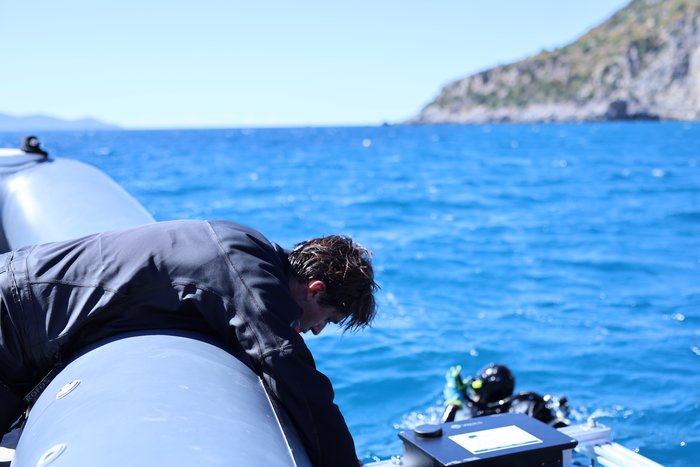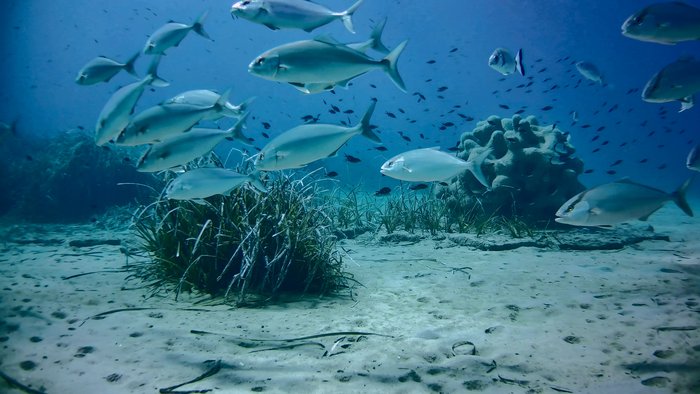
In September 2026 we installed a scientific buoy at Argentario, off Talamone (Tuscany, Italy), connected to a WAILS underwater camera placed on the seabed of the Casa dei Pesci. The project was developed with the University of Siena to continuously monitor the underwater museum and the marine life around it. With the Argentario scientific buoy we bring power and connectivity to the open sea, where there are no sockets and no cables from shore, and we turn seabed images into useful research data through the WAILS platform.Argentario scientific buoy: WAILS and the University of Siena for the Casa dei Pesci underwater museum
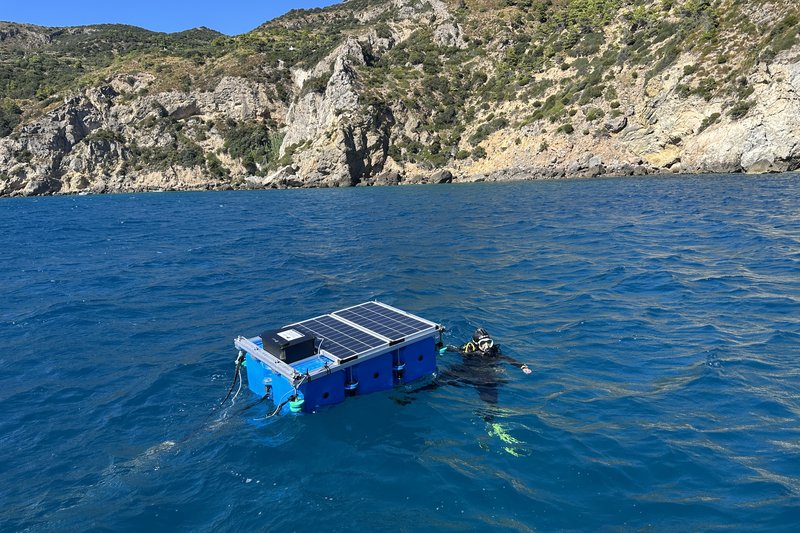
Argentario scientific buoy: what we installed
The system has two parts. On the surface there is the WAILS smart buoy: a floating structure with solar panels and a watertight box holding the power and transmission electronics. On the seabed, fixed to one of the museum’s blocks, there is a WAILS underwater camera connected to the buoy by cable.
The buoy produces the energy the camera needs and sends the images to the platform, so the site can be observed remotely without diving every time.
The partner: University of Siena and the Casa dei Pesci underwater museum
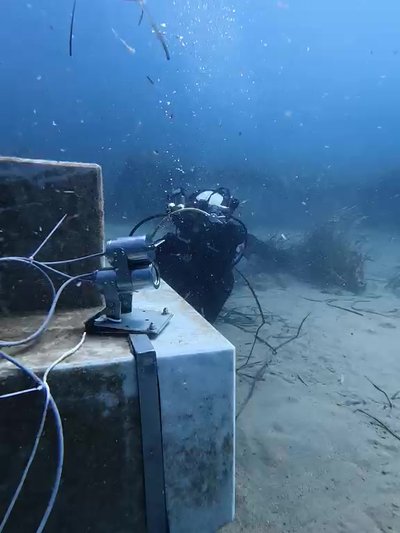
The Casa dei Pesci (House of Fish) is an underwater museum off the coast of Talamone: large stone sculptures placed on the seabed which, besides being works of art, block illegal bottom trawling and protect the Posidonia seagrass meadow.
Together with the University of Siena we chose to monitor this site continuously: to see how the seabed changes, how fish colonise the sculptures and how the Posidonia evolves over time, with images collected every day and not only during dives.
How the Argentario scientific buoy works
The scientific buoy is designed for places with no power grid. Solar panels recharge the batteries, the electronics manage camera power and data transmission, and the modular structure floats steadily even in rough sea.
It is not a closed product: it is an add-on that works with our underwater cameras and sensors, configured case by case according to the site, the depth and the goals of the project.
From Argentario to the platform: images and AI analysis
The images taken on the Casa dei Pesci seabed reach the WAILS platform, where they are stored and analysed. Our artificial intelligence helps detect fish, measure water visibility and compare the condition of the seabed across different periods.
For researchers this means a continuous and comparable data series, instead of single observations scattered over time.
Scientific buoy at Argentario: the installation steps
The work was completed in a single day at sea:
- preparation of the buoy and panels in Talamone harbour;
- transport of the buoy by RIB to the installation point;
- deployment and positioning of the buoy with the help of the divers;
- camera installation on a Casa dei Pesci block and connection to the buoy;
- check of the first images on the platform.
FAQ about the Argentario scientific buoy
Where is the buoy?
Off Talamone, on Monte Argentario (Grosseto, Italy), above the Casa dei Pesci underwater museum.
Who runs the project?
WAILS with the University of Siena, which uses the data for the scientific monitoring of the site.
Can it be replicated elsewhere?
Yes. The scientific buoy can be adapted to marine protected areas, archaeological sites, ports and research projects. Contact us to discuss your case.
Contact Us
WAILS SRL
Via Solferino e San Martino, 14 | 46100 | Mantua (Italy)
Tel. +393409828077 / +393404115627
Email: info@wails.it